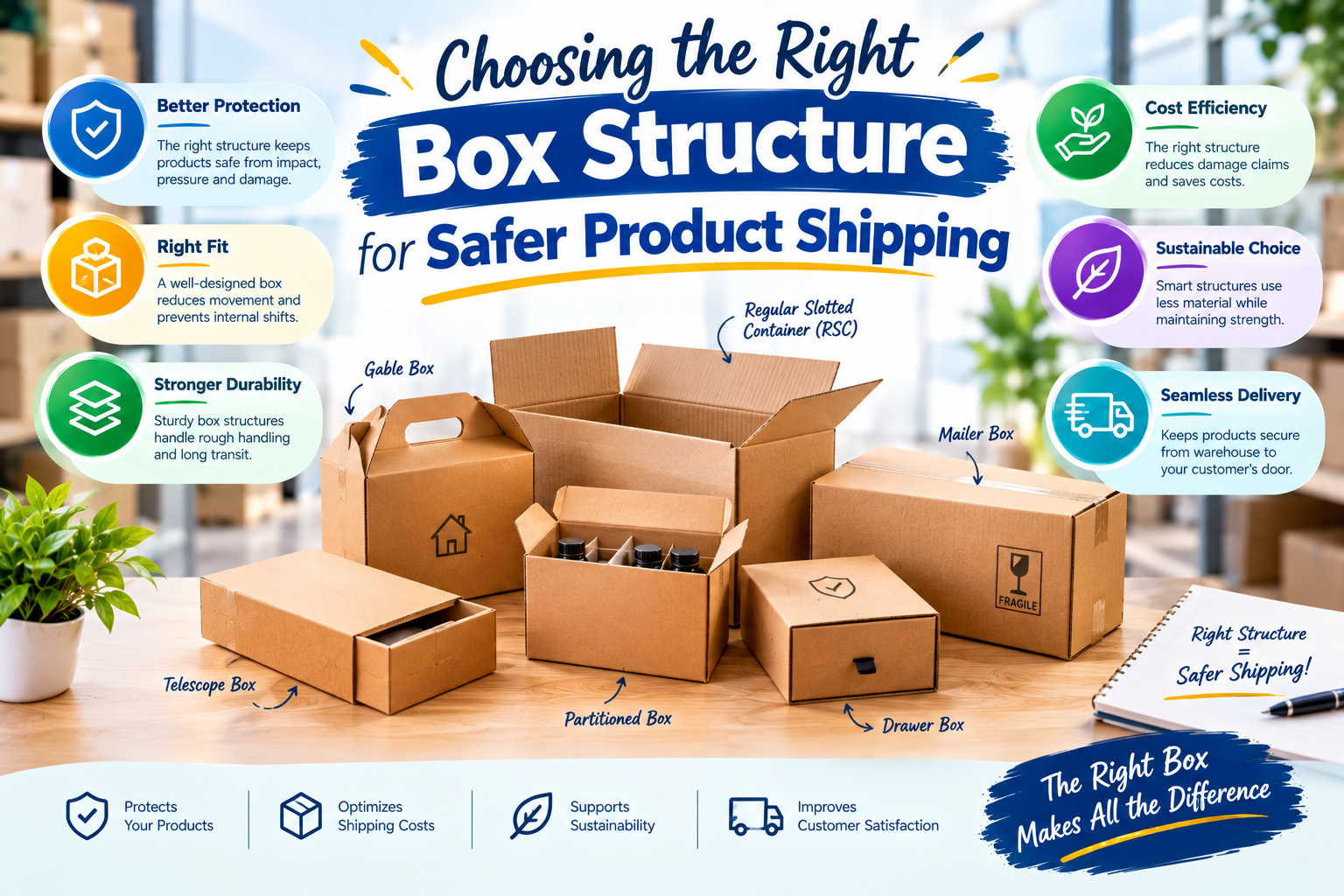
A product can leave a warehouse in perfect condition and still arrive at its destination with damaged corners, broken components, or crushed packaging. Although transportation conditions contribute to these problems, the box itself is often an important part of the solution. The way a box is constructed determines how well it holds its shape, supports its contents, and handles pressure during storage and delivery.
For businesses shipping products regularly, choosing suitable Custom Mailer Boxes can be one way to improve packaging fit and organisation for appropriate products. However, a box should never be selected on appearance alone. Its structure, board strength, dimensions, closure, and internal protection must work together to keep the contents secure throughout the journey.
Why Box Structure Matters More Than Appearance
Two boxes may look almost identical from the outside but perform very differently during transportation. One may hold its shape under pressure, while the other may bend, collapse, or open when handled repeatedly. These differences often come from the materials used and the way the box is designed. Packaging experiences several types of stress during shipping. Parcels may be stacked beneath heavier shipments, moved across conveyor belts, loaded into vehicles, or exposed to repeated handling. A box that works well on a warehouse shelf may not necessarily provide enough protection under these conditions.
The correct structure depends on the product being shipped. Lightweight clothing has different requirements from glass containers, electronic equipment, or heavy household goods. Understanding these differences helps businesses choose packaging that provides suitable protection without adding unnecessary material or expense.
Understanding the Main Types of Box Construction
Box construction refers to how the packaging material is layered, folded, and assembled. Different structures offer different levels of rigidity, cushioning, and support.
Single-Wall Corrugated Boxes
Single-wall corrugated boxes contain one fluted layer between two flat liner sheets. This construction is widely used for everyday shipping because it combines relatively low weight with useful structural support. It can be suitable for many retail products, accessories, books, and other goods when the board specification and box dimensions match the shipment requirements. However, the actual performance depends on the material quality, product weight, box size, and handling conditions.
Double-Wall Corrugated Boxes
Double-wall construction contains two fluted layers separated by three liner sheets. This creates a thicker structure that may provide additional rigidity and protection for heavier products or shipments that experience greater stacking pressure. Businesses shipping multiple items together or products requiring extra support may benefit from considering this option. Nevertheless, double-wall packaging is not automatically necessary for every shipment. Choosing stronger material than the product requires can increase packaging costs without delivering a meaningful improvement.
Folding Cartons
Folding cartons are commonly made from paperboard rather than the fluted structure used in corrugated boxes. They are often used for retail presentation, cosmetics, food products, and lightweight consumer goods. They can provide a neat appearance and organise individual products effectively. For direct shipping, however, their suitability depends on the product’s fragility and whether additional protective packaging is required. The important point is that each structure serves a different purpose. Businesses should select the construction based on the conditions the package will encounter rather than choosing the thickest or most attractive option.
How Corrugated Layers Help Protect Products
Corrugated board contains a wavy paper layer, known as the fluted medium, positioned between flat liner sheets. This design creates a lightweight structure with useful cushioning and resistance to compression. The flute profile, liner quality, and number of layers all influence how the finished box performs. Some constructions prioritise a compact design and smoother printing surface, while others are better suited to applications requiring additional thickness or support.
However, the flute type alone does not determine the strength of a finished box. Its dimensions, board specification, manufacturing quality, and closure also matter. For this reason, businesses should discuss the intended product weight and shipping conditions when selecting corrugated packaging. A suitable combination of materials and construction is more useful than relying on a single specification to predict performance.
Matching Box Design to the Product
One of the most common packaging mistakes is choosing a box based only on the product’s dimensions. Although size is important, the product’s weight distribution, shape, fragility, and movement inside the package also affect protection.
A heavy object placed inside a poorly fitted box may put excessive pressure on the bottom panel. A fragile item surrounded by too much empty space may move during transit and strike the box walls. Even a sturdy carton can fail to protect its contents if the product is not positioned securely.
Before selecting a box, businesses should consider several factors:
- Product weight: The base and walls must support the contents during handling and storage.
- Shape and dimensions: The box should provide a suitable fit without forcing the product into place.
- Fragility: Delicate goods may require inserts, dividers, or additional cushioning.
- Stacking conditions: Shipments that will be stored beneath other cartons may need greater compression resistance.
- Delivery route: Longer journeys and repeated handling may require a different protection strategy from local, short-distance deliveries.
These considerations help businesses choose a box that works for the actual product rather than relying on a general-purpose design for every order.
The Role of Internal Inserts and Cushioning
A strong outer box cannot prevent every type of damage on its own. Internal packaging helps control movement, separate individual items, and protect vulnerable parts of a product. For example, a business shipping several glass containers may need dividers to prevent them from striking one another. An electronic device may require a shaped insert that keeps it away from the box walls. Lightweight products might need only limited void filling, provided they remain securely positioned.
The type of cushioning should match the product’s needs. Too little protection allows movement, while excessive filling can make packing slower and increase material consumption. Businesses should also check that the insert fits correctly after the box is closed. A design that looks secure while open may place unwanted pressure on the product when the flaps are sealed.
Why Box Dimensions and Closures Matter
The dimensions of a box influence both protection and shipping efficiency. A carton that is too large can allow its contents to move, while a box that is too small may compress protective materials or place pressure on delicate surfaces.
Closures are equally important. If the flaps do not meet properly or the sealing method is unsuitable, the package may open during handling. Businesses should use an appropriate shipping tape or closure method and ensure that the seams are securely sealed.
It is also important to measure the complete packed parcel, not just the product. External dimensions can influence shipping charges, while internal dimensions determine how comfortably the product and its protective materials fit. Testing the assembled package with the actual contents can reveal problems that measurements alone may not identify.
Testing Packaging Before Large-Scale Use
A packaging design should be evaluated before it is introduced across a large number of shipments. This is particularly important for fragile, expensive, or regularly transported products. A practical review can include checking whether the product moves inside the box, whether the bottom panel supports its weight, and whether the closure remains secure. Businesses can also assess how cartons behave when stacked under realistic storage conditions.
For products exposed to demanding distribution environments, a suitable transport test may help identify weaknesses before they lead to customer complaints or replacement costs. Testing should reflect the intended shipping method and the complete packed configuration, including inserts and closures. If a package fails, businesses should identify the reason rather than immediately increasing the board thickness. The issue might be an unsuitable box size, weak sealing, insufficient cushioning, or an incorrect choice of construction.
Making Better Packaging Decisions for Long-Term Efficiency
Packaging decisions affect more than product safety. They influence storage requirements, packing time, material consumption, and the overall cost of fulfilling orders. Businesses should review packaging performance using practical information, including damage reports, returns, packing difficulties, and shipping expenses. If a particular product repeatedly arrives with crushed corners, the solution may involve improving edge protection or changing the box construction. If products move excessively inside cartons, better sizing or internal supports may be more effective.
It is also useful to review packaging whenever a product changes in size, weight, or design. A box that worked well for an earlier version may no longer provide the same level of protection. When evaluating Custom Packaging Boxes businesses can consider how the box dimensions, construction, and intended use fit their products and shipping requirements. Comparing samples and assessing the complete packed product before making a large commitment helps ensure that packaging decisions are based on practical performance rather than appearance alone.
Conclusion
Choosing the right box structure requires more than selecting a material that looks strong. Businesses need to consider the product’s weight, dimensions, fragility, transport conditions, and the level of support required inside the package. Corrugated layers, suitable box sizing, secure closures, and well-designed inserts all contribute to a more reliable shipping system.
The most effective packaging is not necessarily the thickest or most expensive option. It is the structure that provides appropriate protection under real shipping conditions while keeping material use and handling requirements practical. By reviewing packaging performance and testing designs before large-scale use, businesses can reduce avoidable damage and make more informed decisions about how their products travel from warehouse to customer.
Frequently Asked Questions
1. What is the best box structure for shipping products?
The best structure depends on the product’s weight, dimensions, fragility, and shipping conditions. Single-wall corrugated boxes suit many everyday shipments, while double-wall construction may be more appropriate for heavier products or demanding handling conditions.
2. What is the difference between single-wall and double-wall boxes?
Single-wall boxes contain one fluted layer between two liners. Double-wall boxes contain two fluted layers and three liners, providing a thicker construction that may offer additional support when correctly specified.
3. Are corrugated boxes suitable for fragile products?
Yes, when the box construction is appropriate and the product is secured with suitable cushioning or inserts. Fragile items may need additional protection depending on their shape and the risks associated with transportation.
4. How does box size affect product protection?
An oversized box may allow products to move during transit, while an undersized box can compress the contents or protective materials. A suitable fit helps limit movement without putting unnecessary pressure on the product.
5. Why are internal packaging inserts important?
Inserts can hold products in position, separate individual items, and protect vulnerable areas. They are especially useful when products have delicate components or need to remain in a specific position during shipping.
6. Does thicker cardboard always provide better protection?
No. Board thickness is only one factor. Box dimensions, material quality, construction, closure, and internal cushioning also influence performance. Packaging should be selected according to the product and its shipping environment.
7. How can businesses prevent boxes from collapsing during shipping?
Businesses can select a suitable board specification, use appropriate box dimensions, avoid exceeding the packaging’s intended load, and consider stacking conditions. Testing the complete packed shipment can help identify structural weaknesses.
8. What should businesses check before choosing shipping boxes?
They should review product weight, dimensions, fragility, delivery conditions, closure requirements, internal protection, and carrier restrictions. Packaging samples can help confirm whether the proposed design works in practice.
9. How can businesses reduce damage caused by products moving inside boxes?
Businesses can choose a better-fitting box, add suitable cushioning, use dividers where needed, and check the finished package before dispatch. The aim is to limit movement without creating excessive pressure on the contents.
10. When should a business review its existing packaging design?
A review is useful when products change, damage complaints increase, shipping expenses rise, or staff experience recurring packing problems. Regular performance checks can reveal whether changes to box construction or internal protection are needed.